Sloths: An Enigmatic World
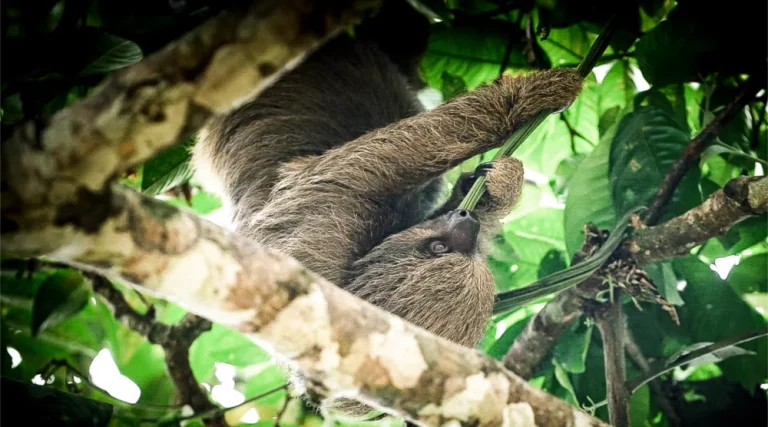
The sloth (Bradypus variegatus), a creature known for its leisurely pace in Central and South America, boasts a dense, grayish-brown to beige coat. With a round head, a flat nose, and hidden ears, this charming creature embodies the epitome of laziness.
With long, slow movements, sloths hang upside down using their specially adapted limbs. Their intricate fingers, fused together, end in long, curved claws for a perfect grip.tunesharemore_vert
These remarkable creatures usually attain a height ranging from 41 to 74 inches (104 to 188 centimeters). Their physical characteristics include a compact and round head, accentuated by large, expressive eyes, a flat nose, and the notable absence of visible ears.
Adapted for arboreal locomotion, sloths are herbivores that have forsaken ground mobility, relying on their specialized anatomy for life in the trees.

Their front legs, particularly those belonging to the three-toed sloth group, are longer, more developed, and possess greater mobility than the hind legs. With around 18 teeth, sloths maintain a body temperature that fluctuates based on the surrounding environment, rendering them physiologically suited for equatorial habitats.
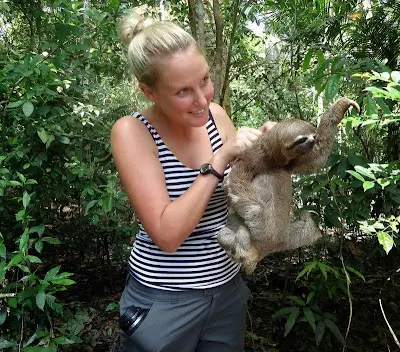
The sloth, renowned for its solitary lifestyle and remarkably long lifespan, navigates its environment with slow and deliberate movements, embracing branches with an unhurried gait while often hanging upside down. Presently, the sloth family comprises six distinct species, categorized into two genera: Four three-toed (Bradypus sp.) and the two two-toed (Choloepus sp.).
These intriguing creatures are leaf-eating explorers, munching on various plants from different trees and vines. Their slow digestion, like a cow’s, helps them get the most nutrients from their food.
Scientific Classification
| Kingdom | Animal |
| Phylum | Vertebrata |
| Class | Mammals |
| Order | Toothless |
| Families | Bradipódidos-megalonychidae |